
Published: August 28, 2026
Last modified: August 28, 2026
Hello,
At the beginning of the month, I learned about an attack on physical Coldcard crypto wallets. Not a theory presented at a conference. People lost actual money.
And the reason is one of the hard practical problems in cryptography: generating random numbers. The hardware module to generate random numbers was there, but a developer disabled that code (probably because they didn’t understand an error they were getting), and the code fell back to a weak software generator. This allowed attackers to regenerate the stream and all the keys generated from it…
A lesson for everyone: randomness is hard.
I hope you’ll find ideas or tools in this newsletter that help you build more secure embedded products (and with good randomness).
If you’d like to react to any of the topics I cover today, just respond to this message.
See you soon,
Marta
Linux kernel 7.2
Linux has reached version 7.2 and celebrated its 35th birthday this month.
The kernel 7.2 includes:
- removal of i486 code and related floating-point emulation
- amd64 support work for memory space randomness is ready, but not enabled because of regressions with KVM
- BPF support has a number of improvements, including lifting the five-argument limit for functions
- cache-awareness scheduling merged https://lwn.net/Articles/1018334/
- more removal of ancient drivers, including the AppleTalk protocol
- the AF_ALG interface to kernel crypto is now deprecated
- the kernel can now create an SPDX SBOM specific to the built kernel (with only included files); the command is
make spdx
Based on summaries from LWN.net and kernelnewbies.org, thank you!
Linux kernel 7.3
Yes, there are already changes ready for 7.3. One that I find interesting is protection of the kernel against misbehaving EFI firmware.
Coldcard crypto wallets randomness problem
This is the subject I wrote about in the introduction. Thanks to version control, we can trace back how the hardware random generator was disabled…
Detailed analysis: https://engineering.block.xyz/blog/predictable-rng-fallback-and-32-bit-reseed-in-coldcard-firmware
Source code repository: https://github.com/Coldcard/firmware
Disassembling firmware
A paper has been published on LLM-assisted firmware disassembly. Not ideal yet, but getting there. And I received confirmation from people actually using LLMs to reverse-engineer firmware that it is working in practice.
The lesson: do not rely on your firmware being available only in binary format. Disassembly is becoming cheaper and cheaper.
Paper link: https://arxiv.org/pdf/2608.06960
Attacks on PLC controllers ongoing
Attacks on industrial systems are ongoing, and the US cybersecurity agency CISA has even issued a warning about them, asking owners to perform basic security operations such as blocking Internet access.
Bleeping Computer reporting: https://www.bleepingcomputer.com/news/security/us-warns-of-ai-powered-attacks-on-siemens-plcs-in-critical-infrastructure/
Spectre on RISC-V
When Spectre/Meltdown vulnerabilities (related to speculative execution) appeared a few years ago, most people considered RISC-V platforms to be too simple to have the same issue. This year’s USENIX paper shows something different. RISC-V designs in productions are vulnerable.
You can read the full paper here: https://lukasgerlach.me/publication/2026-speculative-execution-attacks-on-risc-v-silicon/riscv_spectre_sec26.pdf
CRA and related subjects
There are two organizations working on the official CRA-related standards: ETSI and CEN/CENELEC. ETSI has released all its standards that are currently in official enquiry, so you can read them here: https://docbox.etsi.org/CYBER/EUSR/Open
These are not yet the official versions. If you want your comments to be taken into account, you need to submit them via your national (European) standardization organization. I am reading all the standards and submitting comments, so you can also pass yours to me.
BSI (the German cybersecurity agency) has updated its CRA guidance documents (Part 1 in this case). The complete set of documents is available from the BSI website.
A number of cybersecurity agencies worldwide have jointly released a document on minimum SBOM requirements. You can read it here: https://www.cisa.gov/resources-tools/resources/2026-minimum-elements-software-bill-materials-sbom
The next important date for the CRA is 11 September 2026. Mandatory reporting of exploited vulnerabilities and severe security incidents will be in place. For all devices.
Note that the vendor does not need to use telemetry or similar techniques, but they do need to react to what users or researchers report. I do not expect many companies to actually need to use that reporting mechanism soon.
Podcast
What is a minimal product covered by the CRA is the main question of an episode of the “Ode to resilience” podcast. Summary answer: it needs to be a really simple component. Or a coffee machine without any remote control.
Embedded technology polls
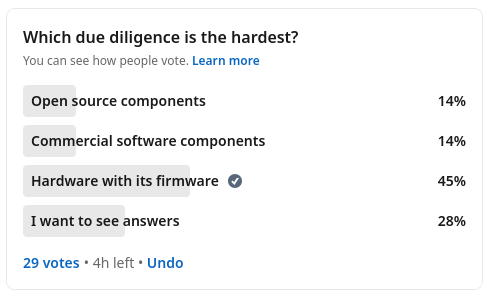
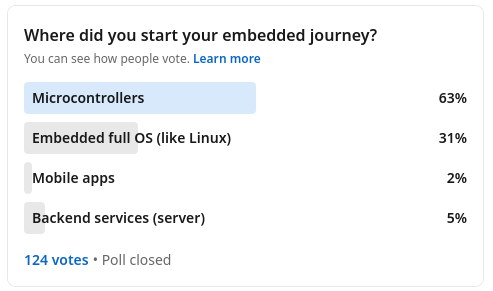
I’ve run a number of polls this month. Some interesting results:
Announcements
If you want to sharpen your embedded security skills, the autumn editions of the Embedded Security course are open, with the first one starting on October 12th: https://ygreky.com/embedded-security-yp/
And for teams preparing for the CRA, we have the CRA Readiness Program, with the first edition starting on October 19th. See more at https://ygreky.com/cra-readiness-program/
My new “Yocto Cookbook” is available for pre-order: https://www.amazon.com/dp/1807607534
Mentions
EmbeddedEdit comes back to the FOSDEM 2026 talk on multiple SBOMs of the same project.
Article link: https://www.embeddededit.com/article/cra-readiness-embedded-teams-sbom
FOSDEM talk link: https://fosdem.org/2026/schedule/event/7YG9H7-embedded-product-with-three-sboms/
Where you can meet us
Kernel Recipes in Paris, 21 September 2026
Open Source Summit and Embedded Linux Conference Europe in Prague, October 2026
EU CRA Day at electronica show in Munich, November 2026
